Pretraining a GPT model

llm
Published

May 4, 2026

Using GPT to generate text

We begin this chapter by intializing the GPT model that we will later evaluate and train using the GPTModel class that we defined in the previous chapter.

import torch

GPT_CONFIG_124M = {
    "vocab_size": 50257,
    "context_length": 256,
    "emb_dim": 768,
    "n_heads": 12,
    "n_layers": 12,
    "drop_rate": 0.1,
    "qkv_bias": False,
}

torch.manual_seed(123)
model = GPTModel(GPT_CONFIG_124M)
model.eval()
GPTModel(
  (tok_emb): Embedding(50257, 768)
  (pos_emb): Embedding(256, 768)
  (drop_emb): Dropout(p=0.1, inplace=False)
  (trf_blocks): Sequential(
    (0): TransformerBlock(
      (att): MultiHeadAttention(
        (W_query): Linear(in_features=768, out_features=768, bias=False)
        (W_key): Linear(in_features=768, out_features=768, bias=False)
        (W_value): Linear(in_features=768, out_features=768, bias=False)
        (out_proj): Linear(in_features=768, out_features=768, bias=True)
        (dropout): Dropout(p=0.1, inplace=False)
      )
      (ff): FeedForward(
        (layers): Sequential(
          (0): Linear(in_features=768, out_features=3072, bias=True)
          (1): GELU()
          (2): Linear(in_features=3072, out_features=768, bias=True)
        )
      )
      (norm1): LayerNorm()
      (norm2): LayerNorm()
      (drop_shortcut): Dropout(p=0.1, inplace=False)
    )
    (1): TransformerBlock(
      (att): MultiHeadAttention(
        (W_query): Linear(in_features=768, out_features=768, bias=False)
        (W_key): Linear(in_features=768, out_features=768, bias=False)
        (W_value): Linear(in_features=768, out_features=768, bias=False)
        (out_proj): Linear(in_features=768, out_features=768, bias=True)
        (dropout): Dropout(p=0.1, inplace=False)
      )
      (ff): FeedForward(
        (layers): Sequential(
          (0): Linear(in_features=768, out_features=3072, bias=True)
          (1): GELU()
          (2): Linear(in_features=3072, out_features=768, bias=True)
        )
      )
      (norm1): LayerNorm()
      (norm2): LayerNorm()
      (drop_shortcut): Dropout(p=0.1, inplace=False)
    )
    (2): TransformerBlock(
      (att): MultiHeadAttention(
        (W_query): Linear(in_features=768, out_features=768, bias=False)
        (W_key): Linear(in_features=768, out_features=768, bias=False)
        (W_value): Linear(in_features=768, out_features=768, bias=False)
        (out_proj): Linear(in_features=768, out_features=768, bias=True)
        (dropout): Dropout(p=0.1, inplace=False)
      )
      (ff): FeedForward(
        (layers): Sequential(
          (0): Linear(in_features=768, out_features=3072, bias=True)
          (1): GELU()
          (2): Linear(in_features=3072, out_features=768, bias=True)
        )
      )
      (norm1): LayerNorm()
      (norm2): LayerNorm()
      (drop_shortcut): Dropout(p=0.1, inplace=False)
    )
    (3): TransformerBlock(
      (att): MultiHeadAttention(
        (W_query): Linear(in_features=768, out_features=768, bias=False)
        (W_key): Linear(in_features=768, out_features=768, bias=False)
        (W_value): Linear(in_features=768, out_features=768, bias=False)
        (out_proj): Linear(in_features=768, out_features=768, bias=True)
        (dropout): Dropout(p=0.1, inplace=False)
      )
      (ff): FeedForward(
        (layers): Sequential(
          (0): Linear(in_features=768, out_features=3072, bias=True)
          (1): GELU()
          (2): Linear(in_features=3072, out_features=768, bias=True)
        )
      )
      (norm1): LayerNorm()
      (norm2): LayerNorm()
      (drop_shortcut): Dropout(p=0.1, inplace=False)
    )
    (4): TransformerBlock(
      (att): MultiHeadAttention(
        (W_query): Linear(in_features=768, out_features=768, bias=False)
        (W_key): Linear(in_features=768, out_features=768, bias=False)
        (W_value): Linear(in_features=768, out_features=768, bias=False)
        (out_proj): Linear(in_features=768, out_features=768, bias=True)
        (dropout): Dropout(p=0.1, inplace=False)
      )
      (ff): FeedForward(
        (layers): Sequential(
          (0): Linear(in_features=768, out_features=3072, bias=True)
          (1): GELU()
          (2): Linear(in_features=3072, out_features=768, bias=True)
        )
      )
      (norm1): LayerNorm()
      (norm2): LayerNorm()
      (drop_shortcut): Dropout(p=0.1, inplace=False)
    )
    (5): TransformerBlock(
      (att): MultiHeadAttention(
        (W_query): Linear(in_features=768, out_features=768, bias=False)
        (W_key): Linear(in_features=768, out_features=768, bias=False)
        (W_value): Linear(in_features=768, out_features=768, bias=False)
        (out_proj): Linear(in_features=768, out_features=768, bias=True)
        (dropout): Dropout(p=0.1, inplace=False)
      )
      (ff): FeedForward(
        (layers): Sequential(
          (0): Linear(in_features=768, out_features=3072, bias=True)
          (1): GELU()
          (2): Linear(in_features=3072, out_features=768, bias=True)
        )
      )
      (norm1): LayerNorm()
      (norm2): LayerNorm()
      (drop_shortcut): Dropout(p=0.1, inplace=False)
    )
    (6): TransformerBlock(
      (att): MultiHeadAttention(
        (W_query): Linear(in_features=768, out_features=768, bias=False)
        (W_key): Linear(in_features=768, out_features=768, bias=False)
        (W_value): Linear(in_features=768, out_features=768, bias=False)
        (out_proj): Linear(in_features=768, out_features=768, bias=True)
        (dropout): Dropout(p=0.1, inplace=False)
      )
      (ff): FeedForward(
        (layers): Sequential(
          (0): Linear(in_features=768, out_features=3072, bias=True)
          (1): GELU()
          (2): Linear(in_features=3072, out_features=768, bias=True)
        )
      )
      (norm1): LayerNorm()
      (norm2): LayerNorm()
      (drop_shortcut): Dropout(p=0.1, inplace=False)
    )
    (7): TransformerBlock(
      (att): MultiHeadAttention(
        (W_query): Linear(in_features=768, out_features=768, bias=False)
        (W_key): Linear(in_features=768, out_features=768, bias=False)
        (W_value): Linear(in_features=768, out_features=768, bias=False)
        (out_proj): Linear(in_features=768, out_features=768, bias=True)
        (dropout): Dropout(p=0.1, inplace=False)
      )
      (ff): FeedForward(
        (layers): Sequential(
          (0): Linear(in_features=768, out_features=3072, bias=True)
          (1): GELU()
          (2): Linear(in_features=3072, out_features=768, bias=True)
        )
      )
      (norm1): LayerNorm()
      (norm2): LayerNorm()
      (drop_shortcut): Dropout(p=0.1, inplace=False)
    )
    (8): TransformerBlock(
      (att): MultiHeadAttention(
        (W_query): Linear(in_features=768, out_features=768, bias=False)
        (W_key): Linear(in_features=768, out_features=768, bias=False)
        (W_value): Linear(in_features=768, out_features=768, bias=False)
        (out_proj): Linear(in_features=768, out_features=768, bias=True)
        (dropout): Dropout(p=0.1, inplace=False)
      )
      (ff): FeedForward(
        (layers): Sequential(
          (0): Linear(in_features=768, out_features=3072, bias=True)
          (1): GELU()
          (2): Linear(in_features=3072, out_features=768, bias=True)
        )
      )
      (norm1): LayerNorm()
      (norm2): LayerNorm()
      (drop_shortcut): Dropout(p=0.1, inplace=False)
    )
    (9): TransformerBlock(
      (att): MultiHeadAttention(
        (W_query): Linear(in_features=768, out_features=768, bias=False)
        (W_key): Linear(in_features=768, out_features=768, bias=False)
        (W_value): Linear(in_features=768, out_features=768, bias=False)
        (out_proj): Linear(in_features=768, out_features=768, bias=True)
        (dropout): Dropout(p=0.1, inplace=False)
      )
      (ff): FeedForward(
        (layers): Sequential(
          (0): Linear(in_features=768, out_features=3072, bias=True)
          (1): GELU()
          (2): Linear(in_features=3072, out_features=768, bias=True)
        )
      )
      (norm1): LayerNorm()
      (norm2): LayerNorm()
      (drop_shortcut): Dropout(p=0.1, inplace=False)
    )
    (10): TransformerBlock(
      (att): MultiHeadAttention(
        (W_query): Linear(in_features=768, out_features=768, bias=False)
        (W_key): Linear(in_features=768, out_features=768, bias=False)
        (W_value): Linear(in_features=768, out_features=768, bias=False)
        (out_proj): Linear(in_features=768, out_features=768, bias=True)
        (dropout): Dropout(p=0.1, inplace=False)
      )
      (ff): FeedForward(
        (layers): Sequential(
          (0): Linear(in_features=768, out_features=3072, bias=True)
          (1): GELU()
          (2): Linear(in_features=3072, out_features=768, bias=True)
        )
      )
      (norm1): LayerNorm()
      (norm2): LayerNorm()
      (drop_shortcut): Dropout(p=0.1, inplace=False)
    )
    (11): TransformerBlock(
      (att): MultiHeadAttention(
        (W_query): Linear(in_features=768, out_features=768, bias=False)
        (W_key): Linear(in_features=768, out_features=768, bias=False)
        (W_value): Linear(in_features=768, out_features=768, bias=False)
        (out_proj): Linear(in_features=768, out_features=768, bias=True)
        (dropout): Dropout(p=0.1, inplace=False)
      )
      (ff): FeedForward(
        (layers): Sequential(
          (0): Linear(in_features=768, out_features=3072, bias=True)
          (1): GELU()
          (2): Linear(in_features=3072, out_features=768, bias=True)
        )
      )
      (norm1): LayerNorm()
      (norm2): LayerNorm()
      (drop_shortcut): Dropout(p=0.1, inplace=False)
    )
  )
  (final_norm): LayerNorm()
  (out_head): Linear(in_features=768, out_features=50257, bias=False)
)
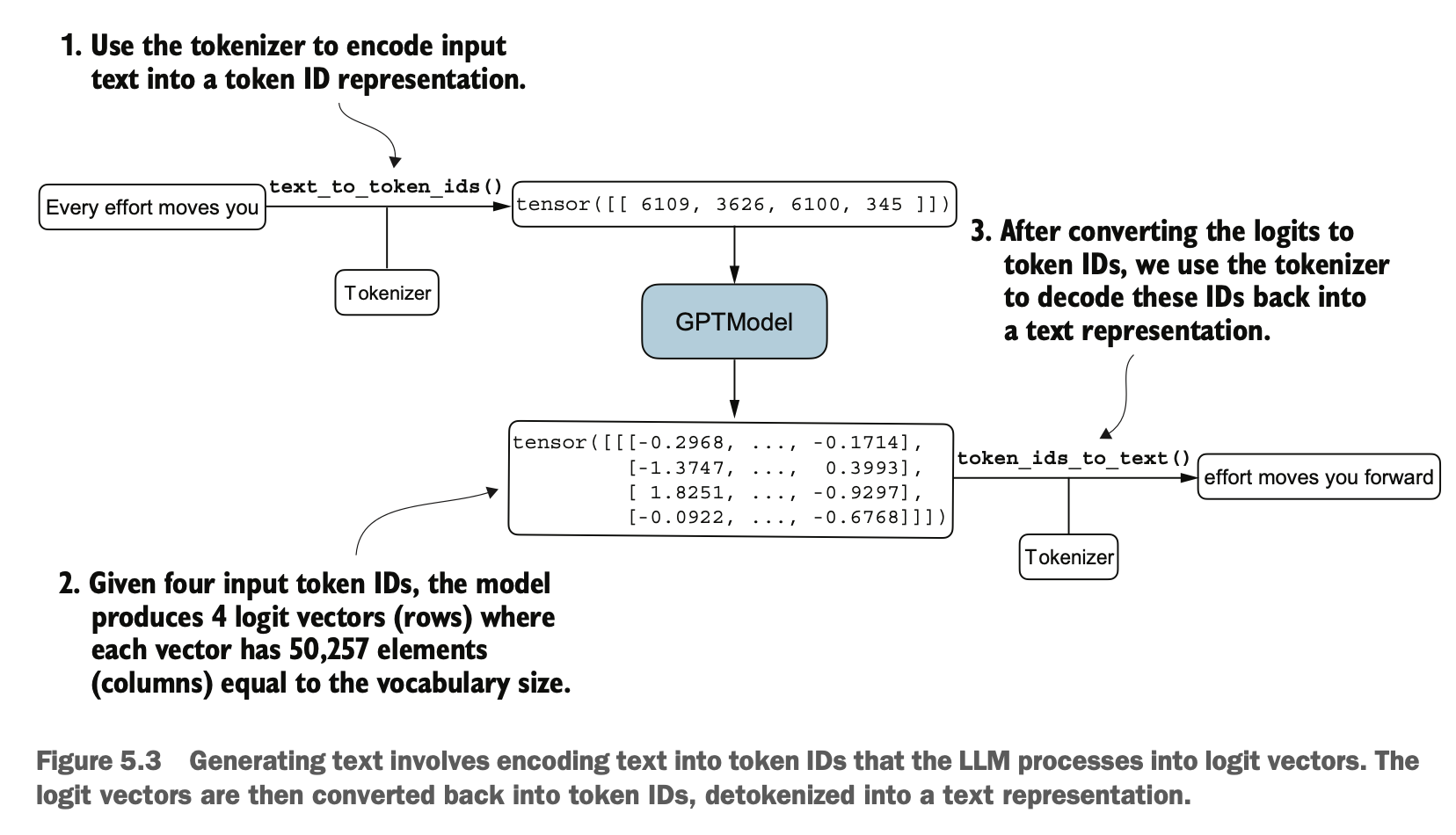
We can now implement the text generation process, using the generate_text_simple from the previous chapter:

import tiktoken

def text_to_token_ids(text, tokenizer):
    encoded = tokenizer.encode(text, allowed_special={"<|endoftext|>"})
    encoded_tensor = torch.tensor(encoded).unsqueeze(0)  # adds batch dimension
    return encoded_tensor

def token_ids_to_text(token_ids, tokenizer):
    flat = token_ids.squeeze(0) # removes the batch dimension
    return tokenizer.decode(flat.tolist())

start_context = "Every effort moves you"
tokenizer = tiktoken.get_encoding("gpt2")


token_ids = generate_text_simple(
    model = model,
    idx = text_to_token_ids(start_context, tokenizer),
    max_new_tokens = 10,
    context_size = GPT_CONFIG_124M["context_length"]
)

print("Output text: ", token_ids_to_text(token_ids, tokenizer))
Output text:  Every effort moves you rentingetic wasnم refres RexMeCHicular stren

Calculating the text generation loss

Consider two inputs examples, which have already been mapped to token ids:

inputs = torch.tensor([[16833, 3626, 6100], # ["every effort moves",
                    [40, 1107, 588]]) # ["I really like"]

Corresponding these inputs, the targets contain the token IDs we want the model to produce:

targets = torch.tensor([[3626, 6100, 345], # ["effort moves you"]
            [1107, 588, 11311]]) # ["really like chocolate"]

Now we feed the inputs into the model to calculate logits vectors for the two input examples, each comprising three tokens. Then we apply the softmax function to transform these logits into probability scores:

with torch.no_grad():       # disable gradient tracking since we are not training
    logits = model(inputs)

probas = torch.softmax(logits, dim=-1)
print(probas.shape) # Shape: [batch_size, seq_len, vocab_size]
torch.Size([2, 3, 50257])

Now we can apply the argmax function to the probability scores to get the predicted token IDs:

predicted_ids = torch.argmax(probas, dim=-1)
print(predicted_ids.shape) # Shape: [batch_size, seq_len]
torch.Size([2, 3])

Finally we can convert the token IDs back into text:

print(f"Target batch 1: {token_ids_to_text(targets[0], tokenizer)}")
print(f"Outputs batch 1: {token_ids_to_text(predicted_ids[0], tokenizer)}")
Target batch 1:  effort moves you
Outputs batch 1:  Armed heNetflix

For each of the two input texts, we can print the initial softmax probability scores corresponding to the target tokens using the following code:

Listing 1: Cross-entropy loss calculation manually
# step 1: compute the probabilities
text_idx = 0
target_probas_1 = probas[text_idx, [0, 1, 2], targets[text_idx]]
print("Text 1:", target_probas_1)

text_idx = 1
target_probas_2 = probas[text_idx, [0, 1, 2], targets[text_idx]]
print("Text 2:", target_probas_2)

# step 2: take the log of the probabilities
log_probas = torch.log(torch.cat((target_probas_1, target_probas_2)))

# step 3: combine log probs into a single score by taking the mean
avg_log_probas = torch.mean(log_probas)
neg_avg_log_probas = avg_log_probas * -1
print(neg_avg_log_probas)
Text 1: tensor([7.4541e-05, 3.1061e-05, 1.1563e-05])
Text 2: tensor([1.0337e-05, 5.6776e-05, 4.7559e-06])
tensor(10.7940)

The goal is to set this average log probability as close to 0 as possible by updating the model parameters. The steps that we do in Listing 1 is the cross-entropy loss. PyTorch has a built-in function that takes care of all these six steps.

NoteCross entropy loss

At its core, the cross entropy loss is a popular measure in machine learning and deep learning that measures the difference between two probability distributions—typically, the true distribution of labels (here, tokens in a dataset) and the predicted distribution from a model (for instance, the token probabilities generated by an LLM).

In the context of machine learning and specifically in frameworks like PyTorch, the cross_entropy function computes this measure for discrete outcomes, which is similar to the negative average log probability of the target tokens given the model’s generated token probabilities, making the terms “cross entropy” and “negative average log probability” related and often used interchangeably in practice.

# check the shape first

print("Logits shape:", logits.shape)
print("Targets shape:", targets.shape)

# flatten the vectors and combine them over batch_dim
logits_flat = logits.flatten(0, 1)
targets_flat = targets.flatten()
print("Flattened logits shape:", logits_flat.shape)
print("Flattened targets shape:", targets_flat.shape)
Logits shape: torch.Size([2, 3, 50257])
Targets shape: torch.Size([2, 3])
Flattened logits shape: torch.Size([6, 50257])
Flattened targets shape: torch.Size([6])

Previously, we applied the softmax function, selected the probability scores corresponding to the target IDs, and computed the negative average log probabilities. PyTorch’s cross_entropy function will take care of all these steps for us:

loss = torch.nn.functional.cross_entropy(logits_flat, targets_flat)
print(loss)
tensor(10.7940)
NotePerplexity

Perplexity is a measure often used alongside cross entropy loss to evaluate the performance of models in tasks like language modeling. It can provide a more interpretable way to understand the uncertainty of a model in predicting the next token in a sequence.

Perplexity measures how well the probability distribution predicted by the model matches the actual distribution of the words in the dataset. Similar to the loss, a lower perplexity indicates that the model predictions are closer to the actual distribution.

Perplexity can be calculated as perplexity = torch.exp(loss). Perplexity is often considered more interpretable than the raw loss value because it signifies the effective vocabulary size about which the model is uncertain at each step. In the given example, this would translate to the model being unsure about which among 48,725 tokens in the vocabulary to generate as the next token.

Calculating the training and validation set losses

file_path = "the-verdict.txt"
with open(file_path, "r", encoding="utf-8") as file:
    text_data = file.read()

# check number of characters and tokens in the dataset
total_characters = len(text_data)
total_tokens = len(tokenizer.encode(text_data))
print(f"Total characters: {total_characters}")
print(f"Total tokens: {total_tokens}")
Total characters: 20479
Total tokens: 5145

Split the data to training and validation set:

train_ratio = 0.9
split_idx = int(train_ratio * len(text_data))
train_data = text_data[:split_idx]
val_data = text_data[split_idx:]

We can now create data loader implemented in the previous chapter:

Create dataset and dataloader code
from torch.utils.data import Dataset, DataLoader

class GPTDatasetV1(Dataset):
    def __init__(self, txt, tokenizer, max_length, stride):
        self.input_ids = []
        self.target_ids = []

        # Tokenize the entire text
        token_ids = tokenizer.encode(txt, allowed_special={"<|endoftext|>"})

        # Use a sliding window to chunk the book into overlapping sequences of max_length
        for i in range(0, len(token_ids) - max_length, stride):
            input_chunk = token_ids[i:i + max_length]
            target_chunk = token_ids[i + 1: i + max_length + 1]
            self.input_ids.append(torch.tensor(input_chunk))
            self.target_ids.append(torch.tensor(target_chunk))

    def __len__(self):
        return len(self.input_ids)

    def __getitem__(self, idx):
        return self.input_ids[idx], self.target_ids[idx]


def create_dataloader_v1(txt, batch_size=4, max_length=256,
                         stride=128, shuffle=True, drop_last=True, num_workers=0):
    # Initialize the tokenizer
    tokenizer = tiktoken.get_encoding("gpt2")

    # Create dataset
    dataset = GPTDatasetV1(txt, tokenizer, max_length, stride)

    # Create dataloader
    dataloader = DataLoader(
        dataset, batch_size=batch_size, shuffle=shuffle, drop_last=drop_last, num_workers=num_workers)

    return dataloader
torch.manual_seed(123)


train_loader = create_dataloader_v1(
    train_data,
    batch_size=2,
    max_length = GPT_CONFIG_124M["context_length"],
    stride = GPT_CONFIG_124M["context_length"],
    shuffle = True,
    drop_last = True,
    num_workers = 0
)

val_loader = create_dataloader_v1(
    val_data,
    batch_size=2,
    max_length = GPT_CONFIG_124M["context_length"],
    stride = GPT_CONFIG_124M["context_length"],
    shuffle = False,
    drop_last = False,
    num_workers = 0
)

# ensure the data were created correctly
print("Train loader:")
for x, y in train_loader:
    print(x.shape, y.shape)


print("\nVal loader:")
for x, y in val_loader:
    print(x.shape, y.shape)
Train loader:
torch.Size([2, 256]) torch.Size([2, 256])

Val loader:
torch.Size([2, 256]) torch.Size([2, 256])

Next we can implement a function to calculate the cross entropy loss of a given batch returned via training and validation loader:

def calc_loss_batch(input_batch, target_batch, model, device):
    input_batch = input_batch.to(device)
    target_batch = target_batch.to(device)
    logits = model(input_batch)
    loss = torch.nn.functional.cross_entropy(
        logits.flatten(0,1),
        target_batch.flatten()
    )
    return loss

def calc_loss_loader(data_loader, model, device, num_batches=None):
    total_loss = 0.0
    if len(data_loader) == 0:
        return float('nan')
    elif num_batches is None:
1        num_batches = len(data_loader)
    else:
2        num_batches = min(num_batches, len(data_loader))
    for i, (input_batch, target_batch) in enumerate(data_loader):
        if i < num_batches:
            loss = calc_loss_batch(
                input_batch, target_batch, model, device
            )
            total_loss += loss.item()
        else:
            break
    return total_loss / num_batches
1
Iteratives over all batches if no fixed num_batches is specified.
2
Reduce the number of batches to the minimum of num_batches and the number of batches in the data loader.

We can now use this function, applying to training and validation set loaders:

if torch.cuda.is_available():
    device = torch.device("cuda")
else:
    device = torch.device("cpu")
model.to(device)

with torch.no_grad():
    train_loss = calc_loss_loader(train_loader, model, device)
    val_loss = calc_loss_loader(val_loader, model, device)

print(f"Train loss:", train_loss) 
print(f"Val loss:", val_loss)
Train loss: 10.987583690219456
Val loss: 10.981106758117676

Training an LLM

def train_model_simple(model, train_loader, val_loader, 
                    optimizer, device, num_epochs, 
                    eval_freq, eval_iter, start_context, tokenizer):
    train_losses, val_losses, track_tokens_seen = [], [], []
    tokens_seen, global_step = 0, -1

    for epoch in range(num_epochs):
        model.train()
        for input_batch, target_batch in train_loader:
            optimizer.zero_grad()
            loss = calc_loss_batch(
                input_batch, target_batch, model, device
            )
            loss.backward()
            optimizer.step()
            tokens_seen += input_batch.numel()
            global_step += 1

            if global_step % eval_freq == 0:
                train_loss, val_loss = evaluate_model(
                    model, train_loader, val_loader, device, eval_iter
                )
                train_losses.append(train_loss)
                val_losses.append(val_loss)
                track_tokens_seen.append(tokens_seen)
                print(f"Epoch {epoch+1}, Step {global_step}, Train loss: {train_loss:.4f}, Val loss: {val_loss:.4f}")

        generate_and_print_sample(
            model, tokenizer, device, start_context
        )

    return train_losses, val_losses, track_tokens_seen
def evaluate_model(model, train_loader, val_loader, device, eval_iter):
    model.eval()
    with torch.no_grad():
        train_loss = calc_loss_loader(
            train_loader, model, device, num_batches=eval_iter
        )
        val_loss = calc_loss_loader(
            val_loader, model, device, num_batches=eval_iter
        )
    model.train()
    return train_loss, val_loss
def generate_and_print_sample(model, tokenizer, device, start_context):
    model.eval()
    context_size = model.pos_emb.weight.shape[0]
    encoded = text_to_token_ids(start_context, tokenizer).to(device)
    with torch.no_grad():
        token_ids = generate_text_simple(
            model=model, idx=encoded,
            max_new_tokens=50, context_size = context_size
        )
    decoded_text = token_ids_to_text(token_ids, tokenizer)
    print(decoded_text.replace("\n", " "))
    model.train()

We can now start training a GPTModel instance for 10 epochs using an AdamW optimizer and the train_model_simple function we defined earlier:

torch.manual_seed(123)

model = GPTModel(GPT_CONFIG_124M)
model.to(device)

optimizer = torch.optim.AdamW(model.parameters(), lr=0.0004, weight_decay=0.1)

num_epochs = 10
train_losses, val_losses, tokens_seen = train_model_simple(
    model, train_loader, val_loader,
    optimizer, device, num_epochs=num_epochs,
    eval_freq=5, eval_iter=5,
    start_context="Every effort moves you",
    tokenizer=tokenizer
)
Epoch 1, Step 0, Train loss: 9.7810, Val loss: 9.9328
Epoch 1, Step 5, Train loss: 8.1105, Val loss: 8.3386
Every effort moves you,,,,,,,,,,,,.                                     
Epoch 2, Step 10, Train loss: 6.6609, Val loss: 7.0480
Epoch 2, Step 15, Train loss: 5.9610, Val loss: 6.6160
Every effort moves you, and, and, and, and, and, and, and, and, and, and, and, and, and, and, and, and, and, and, and, and, and, and,, and, and,
Epoch 3, Step 20, Train loss: 5.7261, Val loss: 6.6004
Epoch 3, Step 25, Train loss: 5.2011, Val loss: 6.3478
Every effort moves you, and I had been.                                            
Epoch 4, Step 30, Train loss: 4.4172, Val loss: 6.2783
Epoch 4, Step 35, Train loss: 4.0687, Val loss: 6.2258
Every effort moves you know the                          "I he had the donkey and I had the and I had the donkey and down the room, I had
Epoch 5, Step 40, Train loss: 3.7321, Val loss: 6.1600
Every effort moves you know it was not that the picture--I had the fact by the last I had been--his, and in the            "Oh, and he said, and down the room, and in
Epoch 6, Step 45, Train loss: 2.8500, Val loss: 6.1786
Epoch 6, Step 50, Train loss: 2.4273, Val loss: 6.1410
Every effort moves you know," was one of the picture. The--I had a little of a little: "Yes, and in fact, and in the picture was, and I had been at my elbow and as his pictures, and down the room, I had
Epoch 7, Step 55, Train loss: 2.1043, Val loss: 6.1340
Epoch 7, Step 60, Train loss: 1.8819, Val loss: 6.2335
Every effort moves you know," was one of the picture for nothing--I told Mrs.  "I was no--as! The women had been, in the moment--as Jack himself, as once one had been the donkey, and were, and in his
Epoch 8, Step 65, Train loss: 1.3204, Val loss: 6.2383
Epoch 8, Step 70, Train loss: 0.9852, Val loss: 6.2424
Every effort moves you know," was one of the axioms he had been the tips of a self-confident moustache, I felt to see a smile behind his close grayish beard--as if he had the donkey. "strongest," as his
Epoch 9, Step 75, Train loss: 0.7165, Val loss: 6.2929
Epoch 9, Step 80, Train loss: 0.5412, Val loss: 6.3931
Every effort moves you?"  "Yes--quite insensible to the irony. She wanted him vindicated--and by me!"  He laughed again, and threw back the window-curtains, I had the donkey. "There were days when I
Epoch 10, Step 85, Train loss: 0.3909, Val loss: 6.4521
Every effort moves you know," was one of the axioms he laid down across the Sevres and silver of an exquisitely appointed luncheon-table, when, on a later day, I had again run over from Monte Carlo; and Mrs. Gis

Decoding strategies to control randomness

We begin by transferring the model back from the GPU to the CPU since infer- ence with a relatively small model does not require a GPU.

model.to("cpu")
model.eval()
GPTModel(
  (tok_emb): Embedding(50257, 768)
  (pos_emb): Embedding(256, 768)
  (drop_emb): Dropout(p=0.1, inplace=False)
  (trf_blocks): Sequential(
    (0): TransformerBlock(
      (att): MultiHeadAttention(
        (W_query): Linear(in_features=768, out_features=768, bias=False)
        (W_key): Linear(in_features=768, out_features=768, bias=False)
        (W_value): Linear(in_features=768, out_features=768, bias=False)
        (out_proj): Linear(in_features=768, out_features=768, bias=True)
        (dropout): Dropout(p=0.1, inplace=False)
      )
      (ff): FeedForward(
        (layers): Sequential(
          (0): Linear(in_features=768, out_features=3072, bias=True)
          (1): GELU()
          (2): Linear(in_features=3072, out_features=768, bias=True)
        )
      )
      (norm1): LayerNorm()
      (norm2): LayerNorm()
      (drop_shortcut): Dropout(p=0.1, inplace=False)
    )
    (1): TransformerBlock(
      (att): MultiHeadAttention(
        (W_query): Linear(in_features=768, out_features=768, bias=False)
        (W_key): Linear(in_features=768, out_features=768, bias=False)
        (W_value): Linear(in_features=768, out_features=768, bias=False)
        (out_proj): Linear(in_features=768, out_features=768, bias=True)
        (dropout): Dropout(p=0.1, inplace=False)
      )
      (ff): FeedForward(
        (layers): Sequential(
          (0): Linear(in_features=768, out_features=3072, bias=True)
          (1): GELU()
          (2): Linear(in_features=3072, out_features=768, bias=True)
        )
      )
      (norm1): LayerNorm()
      (norm2): LayerNorm()
      (drop_shortcut): Dropout(p=0.1, inplace=False)
    )
    (2): TransformerBlock(
      (att): MultiHeadAttention(
        (W_query): Linear(in_features=768, out_features=768, bias=False)
        (W_key): Linear(in_features=768, out_features=768, bias=False)
        (W_value): Linear(in_features=768, out_features=768, bias=False)
        (out_proj): Linear(in_features=768, out_features=768, bias=True)
        (dropout): Dropout(p=0.1, inplace=False)
      )
      (ff): FeedForward(
        (layers): Sequential(
          (0): Linear(in_features=768, out_features=3072, bias=True)
          (1): GELU()
          (2): Linear(in_features=3072, out_features=768, bias=True)
        )
      )
      (norm1): LayerNorm()
      (norm2): LayerNorm()
      (drop_shortcut): Dropout(p=0.1, inplace=False)
    )
    (3): TransformerBlock(
      (att): MultiHeadAttention(
        (W_query): Linear(in_features=768, out_features=768, bias=False)
        (W_key): Linear(in_features=768, out_features=768, bias=False)
        (W_value): Linear(in_features=768, out_features=768, bias=False)
        (out_proj): Linear(in_features=768, out_features=768, bias=True)
        (dropout): Dropout(p=0.1, inplace=False)
      )
      (ff): FeedForward(
        (layers): Sequential(
          (0): Linear(in_features=768, out_features=3072, bias=True)
          (1): GELU()
          (2): Linear(in_features=3072, out_features=768, bias=True)
        )
      )
      (norm1): LayerNorm()
      (norm2): LayerNorm()
      (drop_shortcut): Dropout(p=0.1, inplace=False)
    )
    (4): TransformerBlock(
      (att): MultiHeadAttention(
        (W_query): Linear(in_features=768, out_features=768, bias=False)
        (W_key): Linear(in_features=768, out_features=768, bias=False)
        (W_value): Linear(in_features=768, out_features=768, bias=False)
        (out_proj): Linear(in_features=768, out_features=768, bias=True)
        (dropout): Dropout(p=0.1, inplace=False)
      )
      (ff): FeedForward(
        (layers): Sequential(
          (0): Linear(in_features=768, out_features=3072, bias=True)
          (1): GELU()
          (2): Linear(in_features=3072, out_features=768, bias=True)
        )
      )
      (norm1): LayerNorm()
      (norm2): LayerNorm()
      (drop_shortcut): Dropout(p=0.1, inplace=False)
    )
    (5): TransformerBlock(
      (att): MultiHeadAttention(
        (W_query): Linear(in_features=768, out_features=768, bias=False)
        (W_key): Linear(in_features=768, out_features=768, bias=False)
        (W_value): Linear(in_features=768, out_features=768, bias=False)
        (out_proj): Linear(in_features=768, out_features=768, bias=True)
        (dropout): Dropout(p=0.1, inplace=False)
      )
      (ff): FeedForward(
        (layers): Sequential(
          (0): Linear(in_features=768, out_features=3072, bias=True)
          (1): GELU()
          (2): Linear(in_features=3072, out_features=768, bias=True)
        )
      )
      (norm1): LayerNorm()
      (norm2): LayerNorm()
      (drop_shortcut): Dropout(p=0.1, inplace=False)
    )
    (6): TransformerBlock(
      (att): MultiHeadAttention(
        (W_query): Linear(in_features=768, out_features=768, bias=False)
        (W_key): Linear(in_features=768, out_features=768, bias=False)
        (W_value): Linear(in_features=768, out_features=768, bias=False)
        (out_proj): Linear(in_features=768, out_features=768, bias=True)
        (dropout): Dropout(p=0.1, inplace=False)
      )
      (ff): FeedForward(
        (layers): Sequential(
          (0): Linear(in_features=768, out_features=3072, bias=True)
          (1): GELU()
          (2): Linear(in_features=3072, out_features=768, bias=True)
        )
      )
      (norm1): LayerNorm()
      (norm2): LayerNorm()
      (drop_shortcut): Dropout(p=0.1, inplace=False)
    )
    (7): TransformerBlock(
      (att): MultiHeadAttention(
        (W_query): Linear(in_features=768, out_features=768, bias=False)
        (W_key): Linear(in_features=768, out_features=768, bias=False)
        (W_value): Linear(in_features=768, out_features=768, bias=False)
        (out_proj): Linear(in_features=768, out_features=768, bias=True)
        (dropout): Dropout(p=0.1, inplace=False)
      )
      (ff): FeedForward(
        (layers): Sequential(
          (0): Linear(in_features=768, out_features=3072, bias=True)
          (1): GELU()
          (2): Linear(in_features=3072, out_features=768, bias=True)
        )
      )
      (norm1): LayerNorm()
      (norm2): LayerNorm()
      (drop_shortcut): Dropout(p=0.1, inplace=False)
    )
    (8): TransformerBlock(
      (att): MultiHeadAttention(
        (W_query): Linear(in_features=768, out_features=768, bias=False)
        (W_key): Linear(in_features=768, out_features=768, bias=False)
        (W_value): Linear(in_features=768, out_features=768, bias=False)
        (out_proj): Linear(in_features=768, out_features=768, bias=True)
        (dropout): Dropout(p=0.1, inplace=False)
      )
      (ff): FeedForward(
        (layers): Sequential(
          (0): Linear(in_features=768, out_features=3072, bias=True)
          (1): GELU()
          (2): Linear(in_features=3072, out_features=768, bias=True)
        )
      )
      (norm1): LayerNorm()
      (norm2): LayerNorm()
      (drop_shortcut): Dropout(p=0.1, inplace=False)
    )
    (9): TransformerBlock(
      (att): MultiHeadAttention(
        (W_query): Linear(in_features=768, out_features=768, bias=False)
        (W_key): Linear(in_features=768, out_features=768, bias=False)
        (W_value): Linear(in_features=768, out_features=768, bias=False)
        (out_proj): Linear(in_features=768, out_features=768, bias=True)
        (dropout): Dropout(p=0.1, inplace=False)
      )
      (ff): FeedForward(
        (layers): Sequential(
          (0): Linear(in_features=768, out_features=3072, bias=True)
          (1): GELU()
          (2): Linear(in_features=3072, out_features=768, bias=True)
        )
      )
      (norm1): LayerNorm()
      (norm2): LayerNorm()
      (drop_shortcut): Dropout(p=0.1, inplace=False)
    )
    (10): TransformerBlock(
      (att): MultiHeadAttention(
        (W_query): Linear(in_features=768, out_features=768, bias=False)
        (W_key): Linear(in_features=768, out_features=768, bias=False)
        (W_value): Linear(in_features=768, out_features=768, bias=False)
        (out_proj): Linear(in_features=768, out_features=768, bias=True)
        (dropout): Dropout(p=0.1, inplace=False)
      )
      (ff): FeedForward(
        (layers): Sequential(
          (0): Linear(in_features=768, out_features=3072, bias=True)
          (1): GELU()
          (2): Linear(in_features=3072, out_features=768, bias=True)
        )
      )
      (norm1): LayerNorm()
      (norm2): LayerNorm()
      (drop_shortcut): Dropout(p=0.1, inplace=False)
    )
    (11): TransformerBlock(
      (att): MultiHeadAttention(
        (W_query): Linear(in_features=768, out_features=768, bias=False)
        (W_key): Linear(in_features=768, out_features=768, bias=False)
        (W_value): Linear(in_features=768, out_features=768, bias=False)
        (out_proj): Linear(in_features=768, out_features=768, bias=True)
        (dropout): Dropout(p=0.1, inplace=False)
      )
      (ff): FeedForward(
        (layers): Sequential(
          (0): Linear(in_features=768, out_features=3072, bias=True)
          (1): GELU()
          (2): Linear(in_features=3072, out_features=768, bias=True)
        )
      )
      (norm1): LayerNorm()
      (norm2): LayerNorm()
      (drop_shortcut): Dropout(p=0.1, inplace=False)
    )
  )
  (final_norm): LayerNorm()
  (out_head): Linear(in_features=768, out_features=50257, bias=False)
)

Next we plug the GPTModel instance into the generate_text_simple function to generate text:

tokenizer = tiktoken.get_encoding("gpt2")
token_ids = generate_text_simple(
    model=model,
    idx=text_to_token_ids("Every effort moves you", tokenizer),
    max_new_tokens=25,
    context_size=GPT_CONFIG_124M["context_length"]
)
print("Output text: \n", token_ids_to_text(token_ids, tokenizer))
Output text: 
 Every effort moves you know," was one of the axioms he laid down across the Sevres and silver of an exquisitely appointed lun

Temperature scaling

Let’s now look at temperature scaling, a technique that adds a probabilistic selection process to the next-token generation task. Previously, inside the generate_text_simple function, we always sampled the token with the highest probability as the next token using torch.argmax, also known as greedy decoding. To generate text with more variety, we can replace argmax with a function that samples from a probability distribution (here, the probability scores the LLM generates for each vocabulary entry at each token generation step).

vocab = {
    "closer": 0,
    "every": 1,
    "effort": 2,
    "forward": 3,
    "inches": 4,
    "moves": 5,
    "pizza": 6,
    "toward": 7,
    "you": 8,
}
inverse_vocab = {v: k for k, v in vocab.items()}

Next, assume the LLM is given the start context “every effort moves you” and gener- ates the following next-token logits:

next_token_logits = torch.tensor(
    [4.51, 0.89, -1.90, 6.75, 1.63, -1.62, -1.89, 6.28, 1.79]
)

probas = torch.softmax(next_token_logits, dim=-1)
next_token_id = torch.argmax(probas, dim=-1).item()
print(inverse_vocab[next_token_id])
forward

Probablistic sampling:

def print_sampled_tokens(probas):
    torch.manual_seed(123)
    sample = [torch.multinomial(probas, num_samples=1).item() for i in range(1_000)]
    sampled_ids = torch.bincount(torch.tensor(sample))
    for i, freq in enumerate(sampled_ids):
        print(f"{freq} x {inverse_vocab[i]}")

print_sampled_tokens(probas)
73 x closer
0 x every
0 x effort
582 x forward
2 x inches
0 x moves
0 x pizza
343 x toward

What’s it showing us means that if we replaced the argmax function with the multinomial function inside the generate_and_print_sample function, the LLM would some- times generate texts such as every effort moves you toward, every effort moves you inches, and every effort moves you closer instead of every effort moves you forward. We can further control the distribution and selection process via a concept called temperature scaling. Temperature scaling is just a fancy description for dividing the logits by a number greater than 0:

def softmax_with_temperature(logits, temperature):
    scaled_logits = logits / temperature
    return torch.softmax(scaled_logits, dim=0)

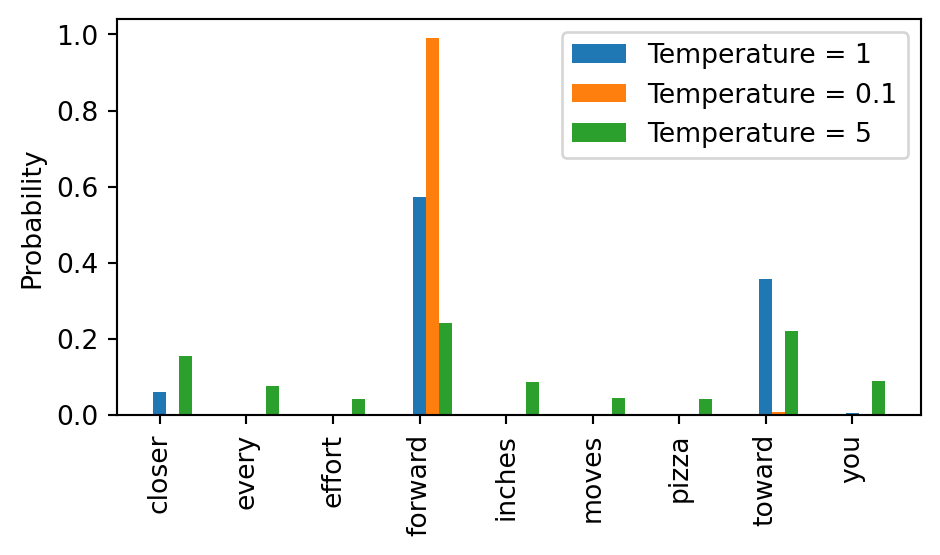
Temperatures greater than 1 result in more uniformly distributed token probabilities, and temperatures smaller than 1 will result in more confident (sharper or more peaky) distributions.

NoteTemperature scaling

Temperature rescales logit differences before exponentiation, and since exponentials magnify differences, that rescaling directly controls how “decisive” the distribution is.

import matplotlib.pyplot as plt

temperatures = [1, 0.1, 5]
scaled_probas = [softmax_with_temperature(next_token_logits, T) for T in temperatures]
x = torch.arange(len(vocab))
bar_width = 0.15
fig, ax = plt.subplots(figsize=(5, 3))

for i, T in enumerate(temperatures):
    rects = ax.bar(x + i * bar_width, scaled_probas[i],

bar_width, label=f'Temperature = {T}')
ax.set_ylabel('Probability')
ax.set_xticks(x)
ax.set_facecolor('none')
ax.set_xticklabels(vocab.keys(), rotation=90)
ax.legend()
plt.tight_layout()
plt.show()

Top-k sampling

One downside of the temperature scaling approach is that it sometimes leads to grammatically incorrect or completely nonsensical outputs such as every effort moves you pizza.

The top-k approach replaces all nonselected logits with negative infinity value (-inf), such that when computing the softmax values, the probability scores of the non-top-k tokens are 0, and the remaining probabilities sum up to 1.

top_k = 3
top_logits, top_pos = torch.topk(next_token_logits, top_k)
print("Top logits: ", top_logits)
print("Top positions: ", top_pos)
Top logits:  tensor([6.7500, 6.2800, 4.5100])
Top positions:  tensor([3, 7, 0])
new_logits = torch.where(
    condition = next_token_logits < top_logits[-1],
    input = torch.tensor(float('-inf')),
    other = next_token_logits
    )

print("New logits: ", new_logits)
New logits:  tensor([4.5100,   -inf,   -inf, 6.7500,   -inf,   -inf,   -inf, 6.2800,   -inf])